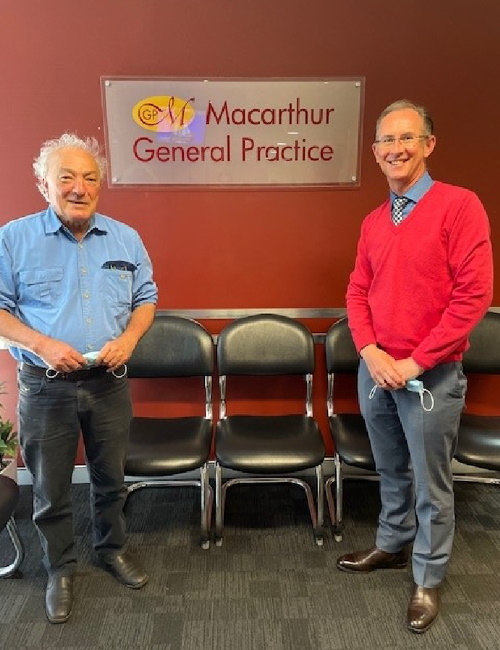
Dr Mike Freelander is the Federal Member for Macarthur, and is a long-standing senior Paediatrician in the region.
SSWGPLink Chair, Dr Ken McCroary, spoke to Dr Freelander about his work in Government to advocate for the health of people with complex care needs, and support for GPs.
Dr Kenneth McCroary, Chair of Sydney South West GP Link, hosts a series of meetings with clinical/political/regional individuals or organisations to discuss issues and solutions for GPs working in South Western Sydney.
Ken McCroary – Good afternoon and welcome to another edition of GP link lunches. My name is Ken McCroary and I am the Chair of GP Link and I am grateful to welcome Dr Mike Freelander, Federal Member for Macarthur.
Mike has been a paediatrician in Campbelltown for nearly four decades and has dedicated his life’s work to make sure our kids get the best start in life.
Mike trained as a paediatrician at the Royal Alexandria Hospital for Children in Camperdown after completing his residency at Royal North Shore Hospital. In 1984, Mike and his wife Sharon moved to the Macarthur region where they raised their six children. At this time, Mike commenced work at Campbelltown Hospital, where he took on the role as head of paediatrics from 1986 to 2013.
Mike set up practices in Campbelltown and Camden because he saw the growing needs of the region not being meet. Despite his workload as a paediatrician, Mike still finds time to give back to his profession, teaching the next generation of doctors as a lecturer at Western Sydney University.
His hard work and dedication in the region have earned him the respect of local families and residents. In his years as a paediatrician in the Macarthur region, Mike has seen more than 200,000 patients. He has increasingly seen his patients and their families face issues of access – access to healthcare, access to work, access to housing and access to education. It is these issues that have drove Mike to run for the Federal seat of Macarthur.
Mike is here to try and make life better for the children he has cared for and their families.
Ken McCroary – So Mike we were planning on talking about the current Senate inquiry into GP and other specialist distribution in the regional and outer metro areas, but I just thought I would start initially by asking you how is life for a politician in the pandemic treating you?
Mike Freelander – Look its interesting and I am still trying to keep some clinical involvement which has been difficult.
I am doing a paediatric clinic at Campbelltown Hospital but the pandemic has changed the world for all of us who work in health and for a politician/paediatrician it has also made life very difficult trying to run our political office without getting too many people visiting and trying to do it all online. I am so over Zoom meetings and things, it’s really quite difficult. I think people will look back at this and realise there is a limit to the amount of online meetings you can have so that has been a difficulty.
I am on the COVID Scientific Committee the government put together – two politicians myself and Cody Allen – and this is the NHMAC COVID-19 Scientific and Medical Research Committee and we look at the different aspects of the pandemic and then provide the reports to the Commonwealth through the Minister for Health and the Chief Health Officer, Paul Kelly. It really is giving me a real indication and education into how premiere research organisations work and I have got a great deal of respect for many of these people like Brendan Crab, Sharon Lewer and John Cowdor, all of the really top infectious diseases specialists and immunologists in the country. I have learned a lot and continue to learn and what I try to avoid is making every aspect of the pandemic weaponised as a political instrument.
I think it is very important, as a doctor in Parliament, I don’t politicise health issues because primarily we do need to get the best health response we can to get us through the pandemic. I am a great supporter of many of the positive things that have happened, our immunisation program and public health policies, which is why you will see most of my social media posts and press releases and things around the response and dealing with the positive aspects of it.
I have learned that politically you have to develop a pretty thick hide because I am the target of a lot of the anti-vaccination sentiment and some people are very negative about the aspects of the pandemic and indeed those that even deny there is even a pandemic. But you need to learn to ignore a lot of that.
So I am enjoying life as a politician but I still want to maintain my ability to practice which is why I am running my clinic and I have developed a great deal of respect for my colleagues around the country who are really coping in a really difficult situation. I think there is one last thing I think people are developing respect for general practice and recognising that primary health care is where our investment needs to be concentrated in the next few decades because we are facing a health revolution with the new treatments that are available and the new aspects of chronic disease in an elderly and ageing population. So more and more of the pressure to support health policy in the next few decades is going to come on general practice and my personal view is we need to support it more.
Ken McCroary – Great thank you for that. Now I might just ask you to tell us a bit more about yourself and which organisation you are representing today please?
Mike Freelander – Well I am representing myself as the Federal Member for Macarthur. I have been in Federal Parliament since 2016. I have a primary focus on healthcare having worked obviously in Macarthur for almost 40 years as a paediatrician and I am on a number of parliamentary committees. I am Co-Chair of the Standing Committee for Health, Aged Care and Support. The chair is Trent Zimmerman, Member for North Sydney, who is a member of the Liberal Party, and we are the primary health committee in parliament that looks at the whole variety of health, care aged care and also support. At present we are just finishing up a major inquiry in how new treatments, including medications, devices and novel therapies, are approved in Australia. It means looking at the TGA, the PBAC, the various device and implantable devices, as well the prosthesis list, in particular how we approve these treatments for use around the country, including during the pandemic. And immunisations, different medications that are now being used, the new anti-inflammatory agents, biologics and the anti viral treatments, and of course all the other medications used in healthcare. This has been a major inquiry. It has taken over a year we have had many public meetings around the country before lockdown and now meetings on zoom and we are just at the present time starting our final report and this will tie up with a whole range of other parliamentary inquiries including medicines, policy to provide an ongoing report to government about how we manage payment and approval for all the new treatments that are coming for a whole variety of diseases in the 21st Century. So It will be a major inquiry and report will be a much looked at and debated once it is out.
Ken McCroary – Great thank you. And looking more regionally, how do and the parties and the organisations and committees you are chairing, and a part of, operate in South Western Sydney.
Mike Freelander – Well we have these inquiries from time to time. Another group I am a member of is the Standing Committee on Social Policy and Legal Affairs. We have recently completed an inquiry into the family law system in Australia and I use my position to encourage local groups to make submissions to these inquiries. The inquiry members are all from different parties so they are quite bipartite and including members of the Labor Party, Liberal Party, National Party and the independent groups and I try and give it a local focus so that people from my electorate get the opportunity to present to federal parliament. Hopefully some results that are a positive for the electorate will come from those inquiries. I also work very strongly with my state colleagues including Greg Warren, Member for Campbelltown, Anoulack Chanthivong, Member for Macquarie Fields, and Peter Sidgreaves, Member for Camden, to try to make sure our local electorates are given a voice in state and federal parliaments. And we work across the political divide, Anoulack and Greg are members of the Labou Party, Peter is a Liberal member, so I try to make sure they are all always included in any of the federal inquires and likewise the state inquires that give a voice to the local community.
Ken McCroary – Now us being a local organisation, I am just wondering if you are aware of any particular issues and challenges that are facing GPs working in South Western Sydney.
Mike Freelander – Well I have worked closely, as you know, with my GP colleagues for a long time and I think I have learned a little bit over the time. The first is I have a great deal of respect for my GP colleagues because you are the backbone of our health system and will be increasingly relied upon. And I think to provide care in the age of complex chronic disease for which there are an increasing number of treatments available, is difficult so respect for my colleagues number one. Number two, a recognition there is a huge issue with workforce recruitment in general practice in particular, and also specialistists, but general practice is the biggest problem within the local area. We need to look at the causes for that and then identify ways that we can make that better and I believe there are two major issues that need to be looked at.
The first thing is that working in practices in south west and outer metropolitan Sydney, our patients tend to be more complex both in terms of medical issues and complex in terms of the psych and social issues and I know from still seeing patients that many of the patients I see as a paediatrician, their families have complex needs in areas of education, housing, jobs and finances and all those issues all have to be dealt with in a background of perhaps things like drug and alcohol abuse, mental health issues, lack of education and that makes dealing with an individual patient really much more difficult or time consuming or stressful and certainly more complex.
We need to support general practice in dealing with those psychosocial and chronic complex issues and that means looking at support practices for general practice. Clinic Nurses, discharge planners, follow up planners ,these sorts of things need to be looked at as a way of supporting general practice. Secondly, and very importantly, we need to look at practice incomes and we need to provide incentives for people wanting to work in often very difficult areas in general practices as away of incentivising people to come here. It is very different seeing a wealthy businessman in Mosman compared to seeing an unemployed man in Campbelltown or Mount Druitt or more disadvantaged areas of Adelaide or Melbourne or Brisbane so we need to be realistic about supporting our GPs and giving them an incentive to want to work in areas that have disadvantage with chronic complex health issues.
Ken MCroary – I guess we should do a bit of discussion about the Senate inquiry you are leading at the moment. It has commenced already I understand.
Mike Freelander – Yes it has commenced a number of hearings. The lockdowns have affected it significantly but there are another 48 hours to get submissions in and we would like as many submissions from outer metropolitan areas as we could because I think what the focus has been on rural, regional and remote health recruitment and I do think there is an issue in recruiting GPs to work in outer metropolitan areas because as we have already mentioned, our patients tend to be complex they often have complex psychosocial issues as well and this takes extra time, impacts on health management, it impacts on follow up and also impacts on treatment. And so recognition that outer metropolitan areas are also an area of workforce need in a way that provides solutions rather than just patch up measures I think is very important. And you need to look at the causes first and then look at solutions and the best people to provide those solutions I believe are the people already working in general practice in outer metropolitan areas. I think we have been hampered very much by the fact that many of the people giving advice about workforce issues have never worked in a general practice in an outer metropolitan, rural or regional area and I think we need to listen to the people that are working at the coalface because we are going to rely on our GP workforce and not just to get us through the pandemic but to deal with the chronic health deficits that are going to come post-pandemic. It is very important we are able to recruit GPs in these areas of great need.
Ken McCoary – I appreciate those sentiments. Now going forward ,what do you think you could do, or your organisation could do, to help and support general practices in South Western Sydney.
Mike Freelander – Well I think as I have said, I think really the first two issues are practice support, what we could do to provide those practices support. I have my own ideas about how we could do proper discharge planning in general practice, proper follow up, it is time consuming, and you need people with health knowledge to do it, but if you do that properly we can take enormous pressure off our public hospital system which is already under huge pressure, so that is the first thing. The second thing is we need to pay people more to work in general practice in areas of need. I strongly believe it, and I think any discussion about the workforce issues without discussing that is not going to get the right answers, we need to pay people more. And number three, we need to also recognise the extra work people in general practice in outer metropolitan areas do is what actually keeps people working, keeps our economy working and it takes it a lot of pressure off our public hospital systems.
Ken McCroary – I really appreciate your wide understanding of general practice out in the regions so I just wish we could get that sentiment across to more of the people making the decisions as you mentioned.
Mike Freelander – Well that is certainly my job.
Ken McCoary – We appreciate that, and we appreciate your time today so thank you very much Mike and thanks for being with us.
 Sydney South West GP Link Ltd.